
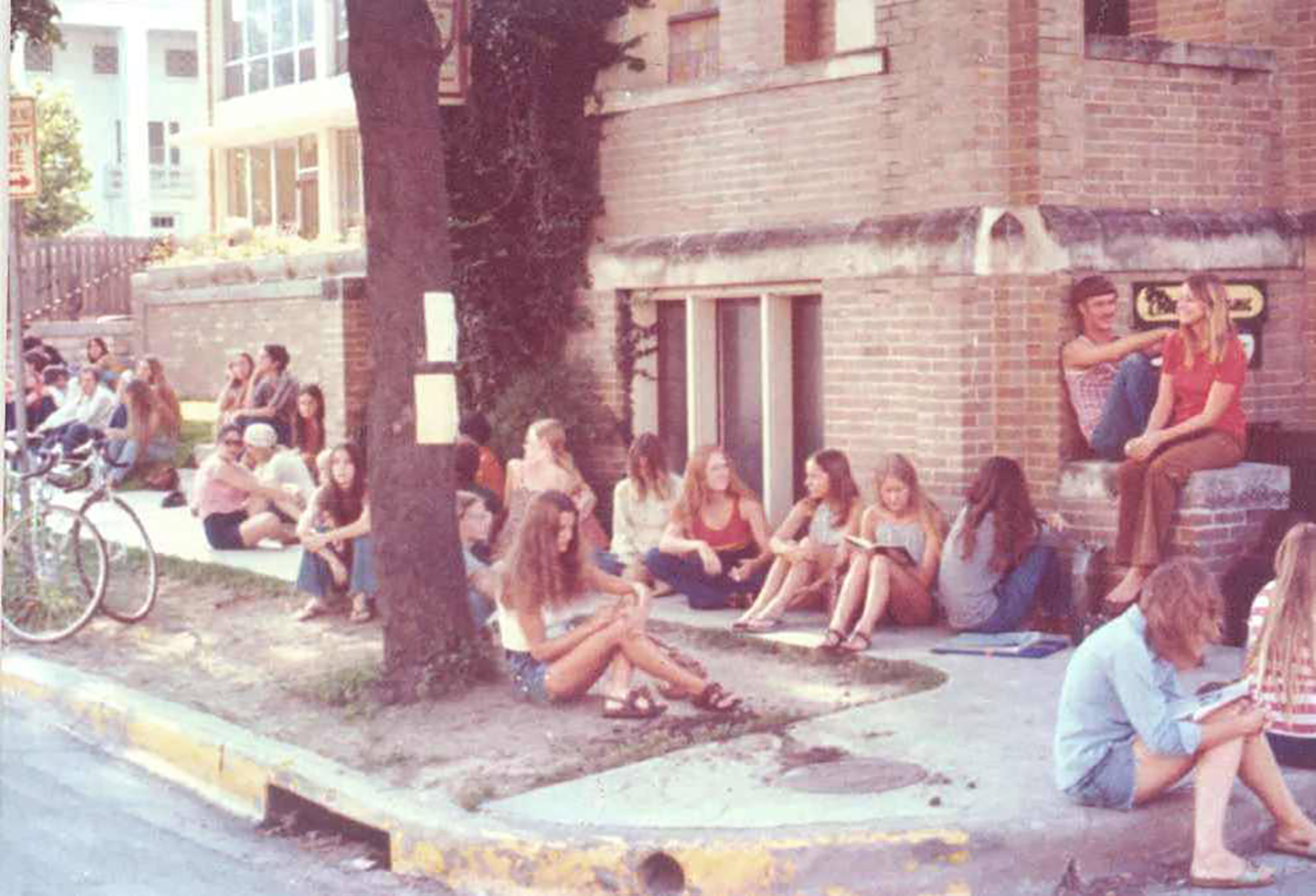
The clinic’s history is a reflection of Austin — from hippies to households. It was founded as People’s Free Clinic in 1970 in the basement of the Congregational Church on Guadalupe Street, across from the UT campus, by a handful of visionary volunteer doctors and nurses.
Initially, the clinic primarily served college students and part-time workers, but today the demand for affordable primary healthcare is significantly greater. The clinic now employs 300 medical and administrative staff members, in addition to numerous volunteers. Then, as now, the clinic is dedicated to improving the health of an increasing number of patients.
Thousands of Central Texans call People’s Community Clinic their medical home. The clinic is a unique and tested model for medical care, a true safety net for the area’s uninsured and medically under-resourced. People’s Community Clinic offers a wide range of health and wellness services, spanning prenatal care through eldercare.
1970:
People’s Free Clinic was established by a group of volunteer doctors and nurses in the basement of the Congregational Church off Guadalupe Street across from the University of Texas. In the early years, the clinic operated two nights per week, and prospective patients lined up around the block for services. Services were offered for free or by donation.
1972:
People’s received its first federal grant for women’s health and family planning services.
1974:
The City of Austin awarded a grant for general medicine services. Travis County awarded funding for prenatal care services. People’s Free Clinic changed its name to People’s Community Clinic.
1982:
Clinic hours: 6:30 – 10:30 p.m. four evenings per week. Budget: $304,000. Clinic staff: 18 full-time; 2 part-time; 80 volunteers.
1985:
People’s initiated one of Texas’ first HIV counseling and testing programs and, in 1986, provided leadership in establishing the first HIV Commission. People’s hired its first full-time physician medical director. Service hours were expanded from 20 to 40 hours per week. Computers were installed for electronic data collection, appointments, and billing.
1990:
People’s moved to its second location at 2909 North IH 35, initiating a $1.5 million capital campaign to purchase and expand the facility. St. David’s Health Care System provided funding for three weekly evening clinics to serve the underserved.
1992:
St. David’s increased support to fund five evening clinics per week. Care was provided 12 hours per day, Monday – Friday. The clinic also won its first “Best of” award from the Austin Chronicle for “Best Public Healthcare,” as it did again in 1996, 1997, 1998, 2006, 2007, and 2008.
1993:
People’s purchased the facility at 2909 North IH 35. The clinic was named the 60th Anniversary project of the Junior League of Austin. The Center for Adolescent Health was established. Walk-in immunization services were implemented five days per week.
1994:
Weekly off-site clinics were established to provide homeless teens with medical and prevention services. Services were provided in collaboration with Youth Options (now the Lifeworks Street Outreach Clinic).
1996:
Clinic renovation and expansion were completed. In collaboration with the American Institute for Learning (now American YouthWorks), the Center for Adolescent Health established the RGK Downtown Center for Health. St. David’s Foundation named People’s Community Clinic as its first major recipient of funds.
1997:
Teen prenatal clinic was established. A pediatric medical director was hired.
1998:
St. David’s Foundation funded the Tandem Teen Prenatal and Parenting Project. The clinic’s budget increased to $2.6 million.
1999:
The Volunteer Specialty Referral Program was initiated to provide People’s patients with extended consultative evaluation and treatment services.
2002:
At the invitation of leading Georgetown citizens, People’s initiates services at the Georgetown Community Clinic. The budget was $4.1 million with 77 full- and part-time staff members. A three-year, $10 million Capacity Campaign was launched, starting with the Nowlin Family’s $1 million lead gift. The Board of Directors, with 100% participation, contributed $705,000.
2003:
Regina Rogoff, JD, became Executive Director. The clinic’s budget reached $4.5 million.
2004:
People’s was named the recipient of the proceeds from the Statesman Capitol 10K race for what would be the first of an unprecedented four-year partnership, from 2004 – 2007. A six-month renovation of the clinic’s facility was completed on schedule and under budget. The Clinic Reunion and Open House celebrated the renovations and the 34th anniversary of the clinic.
2005:
The clinic was awarded the Samaritan Center’s Ethics in Business Award in the non-profit category. The highly successful Capacity Campaign concluded after raising over $5.5 million. Other milestones included the launching of the East Austin Community Health Promoters, the receipt of the first major federal grant for the Center for Adolescent Health’s GOALS Program, and the adoption of a disease registry to monitor several types of chronic illnesses among patients.
2006:
The Chronic Disease Management Program was established to improve the health of patients with conditions such as diabetes and asthma. With funding from the Hogg Foundation and the St. David’s Foundation, People’s launched the Integrated Behavioral Health Initiative. Recruiting 100 donors to give $1,000 each on a sustained basis, the “Council of 100” was kicked off in the last quarter of 2007.
2007:
For the fourth year in a row, People’s was the beneficiary of the Austin American-Statesman’s Capital 10K, and funds were used to launch a Health Literacy Initiative. Patient visits totaled 46,994. The budget reached $6 million.
2008:
Using the “Centering Pregnancy” curriculum, the clinic began offering evening group prenatal visits. The evaluation of the clinic’s Integrated Behavioral Health initiative demonstrated that the program was highly successful in treating patients with mild to moderate symptoms and very cost-effective. The Greater Austin Hispanic Chamber of Commerce presented People’s Community Clinic with the 2008 Non-Profit Leadership Award.
2009:
With a grant from Impact Austin, People’s started Saturday group pediatric visits. In June, People’s launched an off-site clinic at the Austin Children’s Shelter. The clinic began the transition to Electronic Medical Records (EMR).
2010:
A People’s story-collecting campaign launched the clinic’s 40th year festivities. The community celebrated the anniversary with a birthday party in the fall. People’s opened an off-site clinic at SafePlace in collaboration with a partnership called SafeHealth. The People’s Kitchen, a program to teach healthy food preparation techniques, made a trial run. The clinic partnered with the University of Texas at Austin’s Family Wellness Center to establish the Diabetes United program —a group for diabetic patients to learn and share more about living with this chronic disease.
2011:
People’s had its largest “There’s No Such Thing as a Free Lunch” Luncheon to date, hosting 740 guests and raising over $350,000 for the clinic. Hyde Park Bar & Grill selected People’s as the beneficiary of its Healthcare Heroes contest. People’s won Greenlights’ Nonprofit Service Excellence Award.
2012:
People’s was designated as a Federally Qualified Health Center (FQHC) by the U.S. Department of Health and Human Services. This allowed People’s to receive federal grants, offer patients discounted pharmaceutical pricing, and provide medical providers with full employee benefits, among other benefits. The budget hit $10 million. People’s began to consider expansion.
2013:
People’s had its first federal site visit as an FQHC and was found to have met all 19 program requirements. People’s private fundraising was praised as best practice.
2014:
People’s Chief Executive Officer Regina Rogoff, JD, was named “Best Nonprofit CEO” by the Austin Business Journal. People’s was recognized as a Level 3 Patient-Centered Medical Home (the highest level), by the National Committee for Quality Assurance, a private non-profit organization dedicated to improving health care quality. The Greater Austin Hispanic Chamber of Commerce awarded People’s the “Capital of Texas Healthcare Award.”
2015:
People’s broke ground on a brand-new 59,000-square-foot facility in Northeast Austin, with an anticipated move-in date of April 2016. People’s Community Clinic, located at 1101 Camino La Costa, would enable People’s to increase the number of patients served annually from approximately 11,000 to over 20,000. Robin Rosell, People’s Director of Social Services, was awarded Austin Child Guidance Center’s Austin Icon for Children Award for her work creating the Tandem program. Additionally, Dr. Celia Neavel, Director of Adolescent Health at People’s, received the 2015 Health Leader Award from the Texas Medical Association Foundation.
2016:
People’s completed construction of the Northeast Austin clinic in the fall and opened for patients on April 12, 2016. In the new clinic, People’s was able to serve more patients than ever before. The 2909 IH-35 location was repurposed as the People’s Center for Women’s Health and Prenatal Care. In October, People’s inaugurated its new clinic at 1101 Camino La Costa with a grand opening celebration attended by over 1,000 community members.
2017:
As a result of the new 1101 Camino La Costa clinic, People’s increased the number of patient visits by over 20%, and the new People’s Center for Women’s Health and Prenatal Care helped bring about 1000 new babies into the Austin community. People’s Chief Executive Officer Regina Rogoff was awarded Mission Capital’s 2017 Nonprofit Leadership Award.
2018:
Two years after opening 1101 Camino La Costa, People’s closed out its capital campaign with a generous gift from the Moody Foundation. People’s added the Integrative Pain Management Program to address problems of chronic pain and addiction. The clinic was recognized with the Austin Mayor’s Health & Fitness Award for its efforts to promote employee health through on-site yoga, Zumba, and mindfulness classes, as well as designated nursing rooms for mothers.
2019:
People’s became one of the first in Austin to be named an LGBTQ Healthcare Fairness Leader, designated by the Human Rights Campaign. Thanks to a generous donation from the St. David’s Foundation, the clinic opened its first dental program in a refurbished medical van. People’s provided care for a record-breaking 18,564 patients. The budget topped $27 million.
2020:
In response to the COVID-19 pandemic, People’s swiftly adapted its services to continue meeting the needs of the area’s people who are most in need. The clinic established a drive-through for testing, flu immunizations, and other services, implemented virtual visits, expanded Wi-Fi coverage in its parking lot to increase internet access for patients, and enhanced safety measures for both patients and staff. Thanks to Seton and UT Dell Medical School, People’s doctors and providers were able to begin getting vaccinated against COVID-19.
2021:
As the COVID pandemic continued, People’s continued to adopt innovative ways to ensure continuity of care. The clinic implemented a robust telehealth program, screened patients for social determinants of health, and worked diligently to establish and foster relationships with community partners, such as Austin Public Health’s WIC Mobile Unit, half Helen, and the Central Texas Food Bank, to connect patients to local resources. This year, People’s provided care to record-breaking 20,157 patients. The clinic received the Silver Tier Health Center Quality Leader Award, the Advancing Health Information Technology for Quality Award, and the COVID-19 Data Reporter award from the Health Resources and Services Administration, highlighting People’s commitment to providing affordable, high-quality healthcare.
2022:
People’s dental program launched in 2019, offers basic dentistry as well as expanded services such as endodontic, prosthodontic, and restorative dental care to help address issues compromising patients’ quality of life. People’s completed renovation work within the main clinic to transform an existing space into a dental services pod. This expanded the dental program’s capacity to serve more patients by adding seven dental chairs, bringing the total to nine chairs. In partnership with the Central Texas Food Bank, People’s also expanded its wraparound services by establishing on-site food pantries at the main clinic and the People’s Center for Women’s Health. The pantries provide patients who screen positive for food insecurity with immediate access to food on days the pantries are operational.
People’s proudly received renewed recognition as a Silver Tier Health Center Quality Leader by the Health Resources and Services Administration (HRSA). Health Center Quality Leaders achieved the best overall clinical performance among all health centers. Other HRSA awards earned were the Advancing Health Information Technology for Quality award, the Access Enhancer award, the Health Disparities Reducer award, and the Addressing Social Risk Factors award. People’s has also received the Mayor’s Health and Fitness Council’s Gold Level Workplace Partner Certification, a designation given to organizations recognized for having comprehensive health and wellness programs and policies that address the pillars of health.
2023:
Although the public health emergency expired in May 2023, People’s continued to take safety and precaution measures to provide in-person care. In addition to in-person visits, the clinic continued to offer tele-med visits to enhance patient accessibility. This year, People’s provided care to more than 20,000 patients. In addition to primary care, People’s offered a variety of wrap-around services ranging from a food pantry and organic food pop-up market, to halfHelen (eye exams and eyeglasses), the Big Pink Bus (mammograms), WIC and SNAP enrollment assistance, Zumba classes, Medical-Legal Partnership (legal assistance for health-harming legal needs), healthy cooking classes through The Happy Kitchen, among others.
People’s was proud to receive the Bronze Tier Health Center Quality Leader and the Advancing Health Information Technology awards from the Health Resources and Services Administration. People’s also received the Target BP Gold + award in recognition for achieving 70% or greater blood pressure control and committing to accurate measurement among adult patients from The American Heart Association and The American Medical Association.
2024:
People’s was proud to receive the “Advancing Health Information Technology” award from the Health Resources and Services Administration. People’s was also recognized as a “Health Care Fairness Performer” by the Human Rights Campaign Foundation, demonstrating the clinic’s commitment to access for all to high quality, patient-centered care.